Research
QUVED Lab (QUantum Van der Waals Electronic Device Laboratory) focuses on understanding and controlling electronic transport from an energy perspective, with the goal of developing physically grounded concepts for next-generation low-power devices.
The current scaling of electronic systems is no longer limited by functionality, but by energy dissipation. While many emerging approaches propose new device concepts, their physical advantage is often unclear or not rigorously established. Our research starts from this gap.
We study charge, spin, and superconducting transport in van der Waals materials and their heterostructures, where symmetry, dimensionality, and interface effects can be precisely controlled. Rather than introducing complexity, we aim to identify minimal physical ingredients that lead to qualitatively new device behavior.
Our main research directions as follow.
-
Energy Landscape Engineering
Since electronic transport in solid-state systems is fundamentally governed by the electronic band structure, the behavior of charge carriers is determined by the available energy states and how they evolve under external perturbations such as electric fields, interfaces, and symmetry breaking. In low-dimensional and van der Waals materials, these factors can be precisely controlled, leading to rich and tunable transport phenomena.
In our research, we investigate how electronic transport can be understood and controlled from the viewpoint of the underlying electronic structure. By systematically modifying band structures through interface engineering, symmetry control, and external tuning parameters, we aim to uncover the physical mechanisms that give rise to quantum transport behaviors and device functionalities.
Our work goes beyond characterizing transport properties; we actively design and manipulate material systems to realize desired electronic responses. Through this approach, we seek not only to deepen the understanding of quantum transport in low-dimensional systems but also to establish physically grounded pathways toward functional electronic devices.

-
J.-K. Kim et al. Adv. Mater., 33, 2101598 (2021).
-
J.-K. Kim†, et al. Sci. Adv., 8, eabn3181 (2022).
-
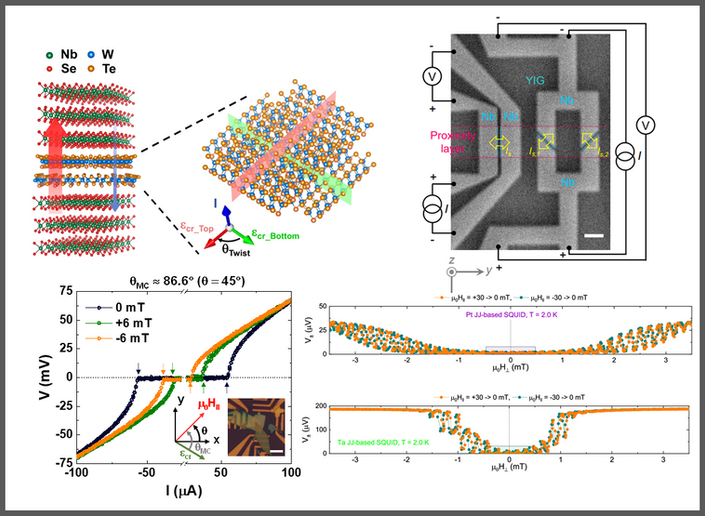
Superconducting and Hybrid Quantum Devices
Superconductivity provides a unique platform where electronic transport is governed not by single-particle band structure alone, but by phase-coherent collective states of paired electrons. In these systems, transport is determined by the superconducting order parameter and its phase, enabling dissipationless current flow and making superconductors promising candidates for low-power electronic applications. At the same time, their behavior is highly sensitive to symmetry, interfaces, and external fields, leading to transport phenomena that go beyond conventional frameworks.
In our research, we investigate superconducting transport in van der Waals and hybrid systems, focusing on how symmetry, spin–orbit coupling, and interfacial effects influence phase-coherent transport. By designing and controlling Josephson junctions and related structures, we aim to uncover the mechanisms behind nonreciprocal supercurrent, phase-dependent transport, and other emergent superconducting responses.
Our work extends beyond observing superconducting phenomena; we actively engineer material combinations and device geometries to realize controlled and reproducible functionalities. Through this approach, we seek to establish superconducting systems as physically well-understood platforms for novel electronic device concepts, where transport behavior can be directly linked to symmetry and quantum coherence, while maintaining their intrinsic advantage for low-dissipation operation.
-
J.-K. Kim et al. Nat. Commun. 15, 1120 (2024).
-
J.-K. Kim†, et al. ACS Nano, 20, 5, 4384–4392 (2026).